Introduction:
Machine learning is no longer a future concept reserved for large technology companies. It is now shaping how businesses understand customers, automate decisions, improve products, reduce costs, and compete in fast-changing digital markets. This is why interest in droven.io machine learning trends continues to grow among founders, marketers, developers, students, and business leaders who want clear insight into where AI-powered technology is heading.
Droven.io focuses on artificial intelligence, emerging technology, and practical digital innovation. When people search for droven.io machine learning trends, they are usually looking for more than basic definitions. They want to know which machine learning developments matter, how these trends affect real businesses, and what skills or tools they should pay attention to next.
Machine learning is becoming more accessible, more automated, more responsible, and more connected to everyday business operations. From AutoML platforms to edge AI devices, from predictive analytics to model monitoring, the direction is clear: machine learning is moving from experimental projects into practical systems that help people make faster and smarter decisions.
Table of Contents
What Are Droven.io Machine Learning Trends?
Droven.io machine learning trends refer to the major changes, tools, practices, and technologies shaping the machine learning landscape. These trends show how businesses and developers are using data-driven models to solve real problems instead of only exploring AI as a buzzword.
Machine learning allows software systems to learn from data, identify patterns, and improve performance without being manually programmed for every single task. In simple terms, it helps computers make predictions, recommendations, classifications, and decisions based on past information.
Today, machine learning is being used in:
- Search engines
- Recommendation systems
- Fraud detection
- Customer support
- Healthcare analysis
- Financial forecasting
- Cybersecurity
- Marketing automation
- Manufacturing
- E-commerce personalization
- Smart devices
The most important trend is not just that machine learning is growing. The real shift is that machine learning is becoming easier to deploy, easier to scale, and more important for business strategy.
Why Machine Learning Trends Matter
Machine learning trends matter because they show where technology, business, and user behavior are moving. A company that understands these trends can make better decisions about tools, hiring, automation, data strategy, and product development.
Ignoring machine learning trends can create several risks:
- Competitors may automate faster
- Customer experiences may feel outdated
- Data may remain unused
- Manual workflows may become expensive
- Security systems may become weaker
- Business decisions may rely too much on guesswork
On the other hand, businesses that follow machine learning trends can use data more effectively, improve efficiency, and build smarter digital systems.
AutoML Is Making Machine Learning Easier
One of the biggest droven.io machine learning trends is the rise of AutoML, also known as automated machine learning. AutoML tools help users build, test, and improve machine learning models with less manual coding.
In the past, building a machine learning model required deep technical knowledge. Teams needed data scientists, machine learning engineers, and advanced programming skills. AutoML does not remove the need for expertise, but it makes the process more accessible.
AutoML can help with:
- Data preparation
- Feature selection
- Model training
- Model comparison
- Performance testing
- Basic deployment
This trend is important because many businesses want the benefits of machine learning but do not have large AI teams. AutoML allows smaller companies, marketers, analysts, and product teams to experiment with machine learning more quickly.
Why AutoML Is Valuable
AutoML saves time and reduces technical barriers. It allows teams to test machine learning ideas faster before investing in full custom development.
For example, an e-commerce brand can use AutoML to predict customer churn, recommend products, or forecast demand without building every model from scratch.
However, AutoML still needs human oversight. Bad data, unclear goals, and poor interpretation can still lead to weak results. The best use of AutoML is not blind automation but guided automation.
MLOps Is Becoming Essential
Another major trend is MLOps, which stands for machine learning operations. MLOps is the practice of managing machine learning models after they are built.
Many companies make the mistake of thinking the work ends once a model is trained. In reality, machine learning models need monitoring, updates, testing, and maintenance. A model that works well today may become less accurate over time if user behavior, market conditions, or data patterns change.
MLOps helps teams manage:
- Model deployment
- Version control
- Performance monitoring
- Data drift
- Model retraining
- Security checks
- Compliance
- Collaboration between teams
Why MLOps Matters
MLOps turns machine learning from a one-time experiment into a reliable business system. Without MLOps, companies may struggle with broken models, inaccurate predictions, and poor trust in AI outputs.
For businesses following droven.io machine learning trends, MLOps is one of the most important areas to understand because it connects machine learning with real-world reliability.
Edge AI Is Moving Machine Learning Closer to Users
Edge AI means running AI or machine learning models directly on devices instead of depending fully on cloud servers. These devices can include phones, cameras, sensors, cars, wearables, and industrial machines.
This trend is growing because businesses want faster responses, better privacy, and lower dependence on constant internet connectivity.
Edge AI can be useful in:
- Smart security cameras
- Self-driving technology
- Healthcare monitoring devices
- Factory sensors
- Retail analytics
- Smart home devices
- Mobile applications
Benefits of Edge AI
Edge AI offers several advantages:
- Faster processing
- Lower latency
- Better privacy
- Reduced cloud costs
- Improved offline functionality
- Real-time decision-making
For example, a smart camera can detect unusual movement locally instead of sending every video frame to a cloud server. This saves bandwidth and improves response time.
Edge AI is one of the most practical machine learning trends because it connects AI directly with physical devices and real-world environments.
Responsible AI Is No Longer Optional
As machine learning becomes more powerful, responsible AI is becoming a major concern. Businesses now need to think about fairness, transparency, privacy, bias, and accountability.
A machine learning model can produce harmful results if it is trained on biased data or used without proper oversight. This is especially important in areas like hiring, lending, healthcare, insurance, education, and law.
Responsible AI focuses on:
- Fair model behavior
- Explainable decisions
- Data privacy
- Bias reduction
- Human oversight
- Safe deployment
- Clear accountability
Why Responsible AI Matters for Businesses
Trust is now a competitive advantage. Users, customers, and regulators want to know how AI systems make decisions. If a company cannot explain or control its AI tools, it risks losing credibility.
For this reason, responsible AI is one of the strongest droven.io machine learning trends. It shows that the future of machine learning is not only about performance. It is also about safety, ethics, and trust.
Predictive Analytics Is Becoming More Practical
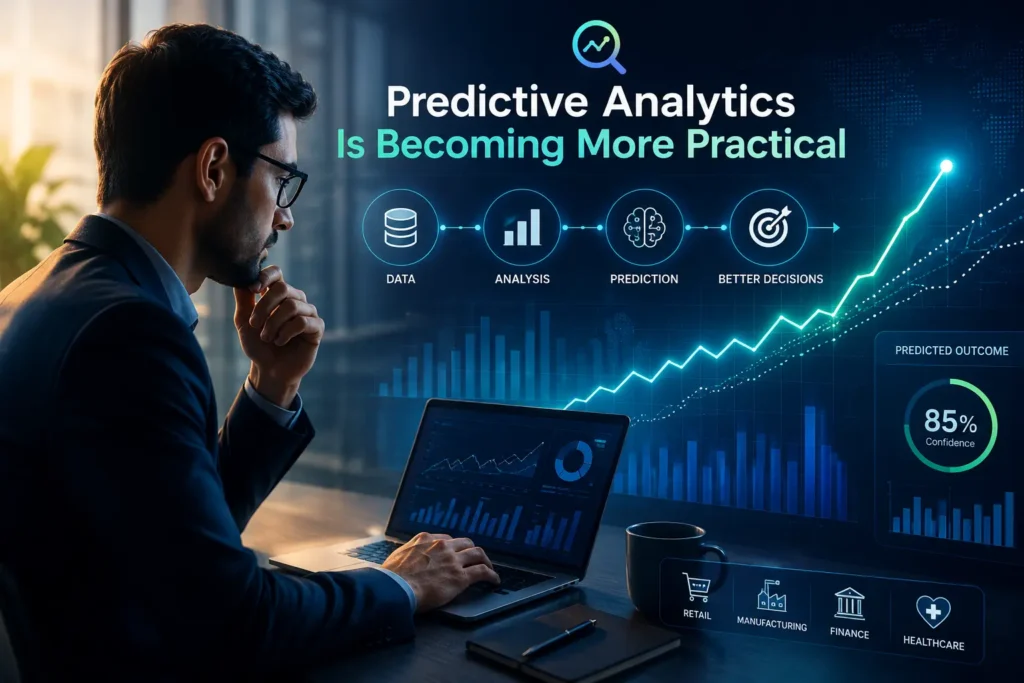
Predictive analytics uses machine learning and historical data to forecast future outcomes. This is one of the most common business uses of machine learning because it helps companies make better decisions.
Predictive analytics can help answer questions like:
- Which customers are likely to leave?
- Which products may sell more next month?
- Which transactions look suspicious?
- Which leads are most likely to convert?
- Which machines may need maintenance soon?
- Which marketing campaign may perform better?
Business Uses of Predictive Analytics
Predictive analytics is useful across many industries:
| Industry | Machine Learning Use | Business Benefit |
|---|---|---|
| E-commerce | Product recommendations | Higher sales and better user experience |
| Finance | Fraud detection | Reduced risk and faster alerts |
| Healthcare | Patient risk prediction | Better planning and early intervention |
| Marketing | Lead scoring | Improved campaign focus |
| Manufacturing | Predictive maintenance | Less downtime and lower repair costs |
| Retail | Demand forecasting | Smarter inventory planning |
| Cybersecurity | Threat detection | Faster response to attacks |
Predictive analytics is valuable because it reduces guesswork. Instead of reacting after problems happen, companies can prepare earlier.
Generative AI and Machine Learning Are Working Together
Generative AI has become one of the most visible parts of artificial intelligence. It can create text, images, code, summaries, ideas, and other content. While generative AI is often discussed separately, it depends heavily on machine learning.
Machine learning helps generative AI systems understand patterns, language, context, and user intent. This combination is changing how people work.
Businesses are using generative AI and machine learning for:
- Content creation
- Customer support
- Code assistance
- Data analysis
- Email automation
- Research summaries
- Product descriptions
- Knowledge management
The Shift From Tools to Workflows
The next stage is not just using AI tools one by one. The bigger trend is building AI-powered workflows where machine learning supports everyday tasks.
For example, a marketing team may use AI to analyze customer data, create audience segments, generate campaign ideas, predict performance, and optimize content. This creates a smarter workflow instead of a single isolated tool.
Anchor text: href
Small Language Models Are Gaining Attention
Large AI models receive most of the attention, but smaller and more efficient models are becoming increasingly important. These models are designed to run faster, cost less, and serve specific business needs.
Small language models can be useful when a company does not need a massive general-purpose model. A focused model trained or tuned for one domain can sometimes be more practical.
Why Smaller Models Matter
Smaller models can offer:
- Lower operating costs
- Faster response times
- Easier deployment
- Better privacy control
- Industry-specific performance
- Lower hardware requirements
This trend matters for businesses that want AI value without unnecessary complexity. Not every company needs the biggest model. Many need the right model for the right task.
Data Quality Is Becoming More Important Than Model Size
A common mistake in machine learning is focusing only on algorithms or tools while ignoring data quality. Even the most advanced model will perform poorly if the data is messy, incomplete, outdated, or biased.
Good machine learning depends on good data.
Important data quality factors include:
- Accuracy
- Completeness
- Consistency
- Relevance
- Freshness
- Proper labeling
- Privacy compliance
Clean Data Creates Better AI
Businesses that invest in data quality often get better results from machine learning. Clean data helps models learn the right patterns and avoid misleading predictions.
This is why one of the most practical droven.io machine learning trends is the growing focus on data foundations. Before a company builds advanced AI systems, it must understand what data it has and whether that data can be trusted.
Machine Learning in Cybersecurity Is Expanding
Cybersecurity is another major area where machine learning is becoming essential. As online threats become more complex, traditional rule-based security systems are not always enough.
Machine learning can help detect unusual activity, suspicious behavior, malware patterns, phishing attempts, and network risks.
How Machine Learning Helps Security Teams
Machine learning can support cybersecurity by:
- Detecting abnormal login behavior
- Identifying suspicious transactions
- Spotting phishing patterns
- Monitoring network traffic
- Prioritizing security alerts
- Reducing manual investigation time
However, attackers can also use AI tools. This means companies must improve both their defensive technology and their internal security awareness.
Machine learning in cybersecurity is not only about automation. It is about faster detection, smarter alerts, and better risk management.
Personalization Is Becoming More Advanced
Personalization is one of the most familiar uses of machine learning. Users see it every day in search results, shopping suggestions, streaming platforms, social feeds, and email recommendations.
The next stage of personalization is more context-aware. Instead of showing generic recommendations, machine learning systems can understand timing, behavior, intent, location, purchase history, and user preferences.
Examples of Machine Learning Personalization
Personalization can appear in many ways:
- Product recommendations
- Dynamic website content
- Personalized emails
- Search result ranking
- Custom learning paths
- Smart app notifications
- Tailored pricing suggestions
- Content recommendations
Good personalization improves user experience. Bad personalization can feel intrusive. This is why companies must balance relevance with privacy.
Machine Learning Is Changing Digital Marketing
Digital marketing is one of the fields most affected by machine learning. Marketers now use AI-powered systems to analyze audiences, predict behavior, optimize ads, improve content, and understand customer journeys.
Machine learning can help marketers with:
- Keyword clustering
- Content planning
- Audience segmentation
- Ad performance prediction
- Conversion tracking
- Customer lifetime value analysis
- Email personalization
- Sentiment analysis
Why Marketers Should Follow Machine Learning Trends
Marketing is becoming more data-driven. Brands that understand machine learning can create better campaigns, reduce wasted budget, and improve customer targeting.
However, machine learning should support creativity, not replace it completely. The best marketing still needs human insight, brand voice, emotional understanding, and original strategy.
Machine Learning Skills Are Becoming More Valuable
As businesses adopt AI tools, machine learning skills are becoming more important across different roles. It is no longer only data scientists who need to understand machine learning. Product managers, marketers, analysts, developers, founders, and content strategists can all benefit from basic ML knowledge.
Important machine learning skills include:
- Understanding data
- Knowing how models work
- Reading analytics
- Using AI tools responsibly
- Understanding bias and privacy
- Interpreting predictions
- Asking better business questions
Practical Skills Matter More Than Theory Alone
Not everyone needs to become a machine learning engineer. But many professionals should understand how machine learning affects their work.
A business owner should know what machine learning can and cannot do. A marketer should know how predictive tools influence campaigns. A developer should understand model integration. A content strategist should understand AI-assisted workflows.
This practical understanding is what makes machine learning useful in real business environments.
Comparison: Traditional Software vs Machine Learning Systems
| Feature | Traditional Software | Machine Learning System |
|---|---|---|
| Main approach | Follows fixed rules | Learns patterns from data |
| Flexibility | Limited unless manually updated | Can improve with new data |
| Best use | Clear, rule-based tasks | Prediction, classification, personalization |
| Data dependency | Usually lower | Very high |
| Maintenance | Code updates | Model monitoring and retraining |
| Risk | Logic errors | Bias, drift, inaccurate predictions |
| Business value | Automation and consistency | Smarter decisions and adaptive systems |
Traditional software is still important, but machine learning adds a new layer of intelligence. The strongest digital products often combine both.
Challenges Behind Machine Learning Trends
Machine learning has strong potential, but it also comes with challenges. Businesses should not treat it as magic. A successful machine learning strategy needs planning, clean data, skilled people, and clear goals.
Common challenges include:
- Poor data quality
- High implementation costs
- Lack of skilled teams
- Model bias
- Privacy concerns
- Difficult model monitoring
- Overdependence on automation
- Unclear business goals
- Weak integration with existing systems
The Biggest Mistake Businesses Make
The biggest mistake is starting with the tool instead of the problem. A company should first ask:
- What problem are we solving?
- What data do we have?
- How will success be measured?
- Who will use the output?
- What happens if the model is wrong?
- How will the system be monitored?
Machine learning works best when it is connected to a clear business outcome.
How Businesses Can Prepare for Machine Learning Trends
Companies do not need to adopt every new trend immediately. A smarter approach is to build strong foundations and choose trends that match business goals.
Start With Data Readiness
Before using machine learning, businesses should organize their data. This includes cleaning records, removing duplicates, improving tracking, and making sure data is stored securely.
Choose a Clear Use Case
Start with one practical use case such as customer churn prediction, demand forecasting, fraud detection, or content recommendation.
Use the Right Tools
Not every project needs a custom model. Some teams can start with AutoML tools, analytics platforms, or AI-powered business software.
Keep Humans in the Loop
Machine learning should support human decisions, especially in sensitive areas. Human review helps reduce risk and improve trust.
Monitor Results Over Time
A machine learning model should be checked regularly. Performance can change when user behavior, market trends, or data patterns shift.
Future of Droven.io Machine Learning Trends
The future of droven.io machine learning trends will likely focus on practical adoption, smarter automation, responsible AI, and business-ready tools. The most successful companies will not be the ones that chase every AI trend. They will be the ones that understand which machine learning solutions create real value.
Future machine learning will become:
- More automated
- More explainable
- More accessible
- More privacy-focused
- More industry-specific
- More connected to daily workflows
- More important for decision-making
Machine learning will continue moving behind the scenes of apps, websites, platforms, devices, and business systems. Users may not always notice it directly, but they will experience its impact through faster service, better recommendations, smarter products, and more personalized digital experiences.
FAQs
What is the main focus of droven.io machine learning trends?
The main focus of droven.io machine learning trends is understanding how machine learning is changing business, technology, automation, data analysis, and AI-powered decision-making.
Why are machine learning trends important?
Machine learning trends are important because they help businesses understand where technology is moving and how to use data more effectively for better decisions, automation, and customer experiences.
What is AutoML in machine learning?
AutoML means automated machine learning. It helps users build and test machine learning models with less manual coding by automating parts of data preparation, model selection, training, and evaluation.
What is MLOps?
MLOps is the process of managing machine learning models after they are created. It includes deployment, monitoring, version control, retraining, and performance management.
How does machine learning help businesses?
Machine learning helps businesses predict trends, personalize customer experiences, detect fraud, automate tasks, improve marketing, forecast demand, and make better data-driven decisions.
Is machine learning only for large companies?
No, machine learning is no longer only for large companies. With AutoML tools, cloud platforms, and AI-powered software, smaller businesses can also use machine learning for practical tasks.
What is the biggest challenge in machine learning?
The biggest challenge is often poor data quality. If the data is inaccurate, incomplete, or biased, the machine learning model may produce weak or misleading results.
What is the future of machine learning?
The future of machine learning will focus on automation, responsible AI, edge AI, predictive analytics, better data quality, and practical business use cases.
Conclusion
Droven.io machine learning trends show how quickly artificial intelligence is becoming part of everyday business and technology. Machine learning is no longer just about complex models or technical experiments. It is now about solving real problems, improving decisions, reducing manual work, and creating smarter digital experiences.
The most important trends include AutoML, MLOps, edge AI, responsible AI, predictive analytics, personalization, cybersecurity, and better data quality. Each trend points toward the same future: machine learning will become more practical, more reliable, and more deeply connected to business growth.
For businesses, the best approach is not to chase every trend at once. The smarter path is to understand the problem, prepare the data, choose the right tools, keep human oversight, and measure results carefully. Companies that do this well will be better prepared for the next stage of AI-driven innovation.