Introduction
Artificial intelligence is changing how businesses operate, compete, and make decisions. From automating repetitive tasks to improving customer experiences and analyzing business information, AI is becoming part of everyday operations rather than remaining a technology reserved for large enterprises.
In this environment, droven.io ai for business represents an important concept: using accessible AI knowledge and practical automation ideas to understand where artificial intelligence can create genuine business value. Rather than treating AI as a collection of trendy tools, businesses can approach it as a strategic capability that connects data, workflows, employees, customers, and decision-making.
Droven.io focuses on AI, automation, machine learning, cloud computing, cybersecurity, and other emerging technologies, making it useful for businesses and professionals trying to understand how these technologies fit together. The platform is positioned more as an educational and knowledge resource than as a single software product.
what is droven.io ai for business?
Droven.io AI for business can be understood as the practical use of AI-related knowledge, automation concepts, and emerging technology insights to help organizations identify better ways to work.
Businesses often face the same challenge: there are hundreds of AI products available, but choosing a useful solution requires understanding the underlying business problem first.
A company may need to:
- Reduce repetitive administrative work
- Improve customer support
- Organize internal knowledge
- Analyze large amounts of information
- Automate lead management
- Improve marketing workflows
- Support employees with AI assistants
- Make faster data-driven decisions
- Connect disconnected business systems
- Improve operational efficiency
The value of an AI-focused knowledge platform is therefore not simply knowing which AI tools exist. The bigger advantage is understanding where AI belongs in the business process and where it does not.
why businesses are paying attention to ai
Traditional business software usually performs predefined functions. AI introduces a more flexible layer that can understand language, identify patterns, generate content, summarize information, classify data, and assist with decisions.
This creates opportunities across almost every department.
For example, a sales team can use AI to summarize customer conversations, while a support department can use AI to categorize tickets and provide suggested responses. Marketing teams can automate content workflows, and operations teams can use AI to identify bottlenecks.
However, successful implementation depends on more than simply purchasing an AI subscription.
A business should first understand:
- What problem needs to be solved?
- How much time is currently spent on the problem?
- What data is available?
- Which systems need to communicate?
- What level of human oversight is necessary?
- How will success be measured?
- What privacy and security requirements apply?
This business-first approach makes AI adoption more practical and reduces the risk of implementing technology without a clear purpose.
how droven.io can support business ai understanding
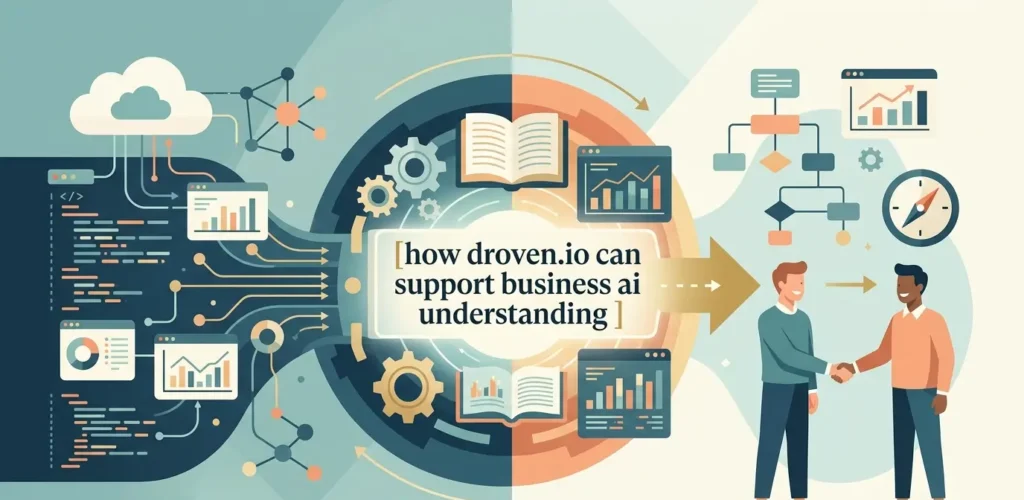
One of the strongest areas associated with droven.io is its broad coverage of AI and automation topics. Its content discusses artificial intelligence, generative AI, workflow automation, RPA, machine learning, cloud computing, cybersecurity, and technology careers.
For businesses, this broad perspective can help connect individual technologies with larger digital transformation goals.
ai and generative ai
Generative AI can assist with tasks involving text, documents, research, communication, summarization, brainstorming, and knowledge retrieval.
Businesses can investigate applications such as:
- Internal AI assistants
- Customer communication
- Document summarization
- Knowledge management
- Content production
- Research assistance
- Proposal generation
- Employee support
The important point is that generative AI should support a defined workflow rather than simply being added because it is popular.
workflow automation
Workflow automation connects business applications and allows repetitive processes to happen with less manual intervention.
A basic workflow could look like:
customer inquiry → lead capture → CRM entry → qualification → notification → follow-up
AI can make these workflows more intelligent by helping classify information, understand customer messages, prioritize leads, or generate appropriate responses.
robotic process automation
RPA focuses on repetitive digital tasks that traditionally require employees to interact with software manually.
Potential examples include:
- Data entry
- Invoice processing
- Report preparation
- File movement
- Information extraction
- Repetitive administrative updates
RPA becomes particularly useful when businesses have structured, predictable processes that consume significant employee time.
droven.io ai in digital transformation
The phrase drovenio ai in digital transformation describes a broader business opportunity than simply adopting an AI chatbot.
Digital transformation involves changing how an organization operates through technology, data, automation, and improved processes.
AI can become one layer of that transformation.
A modern transformation strategy may connect:
| Business area | AI or automation opportunity | Potential benefit |
|---|---|---|
| Sales | Lead scoring and automated follow-ups | Faster response times |
| Marketing | Content and audience analysis | Greater productivity |
| Customer service | AI assistants and ticket classification | Faster support |
| Finance | Document and invoice processing | Less manual work |
| HR | Employee knowledge assistants | Easier information access |
| Operations | Workflow automation | Reduced repetitive work |
| Management | Data analysis and forecasting | Better decisions |
| IT | Monitoring and intelligent support | Faster issue resolution |
The strongest transformation projects usually begin with business processes rather than technology names.
Instead of asking, “Which AI tool should we buy?”, a company can ask, “Which process is slowing our business down, and can AI improve it?”
That change in perspective can lead to much better technology decisions.
key business use cases for droven.io ai
AI can influence almost every stage of a company’s operations. The most valuable opportunities are generally those where repetitive work, large amounts of information, or slow decision-making create measurable costs.
customer service automation
Customer support teams receive repetitive questions every day. AI assistants can help answer common queries, summarize conversations, categorize tickets, and route complex issues to human employees.
Human agents can then spend more time handling situations that require judgment and empathy.
sales and lead management
Sales teams can use AI to organize leads, summarize conversations, identify potential opportunities, and support follow-up workflows.
An automated system can potentially reduce the amount of manual data entry required after customer interactions.
marketing operations
AI can help marketing teams research audiences, analyze campaign information, generate drafts, organize content ideas, and automate parts of campaign workflows.
The goal should not be to replace creative strategy. Instead, AI can handle repetitive work and allow marketers to spend more time on positioning, strategy, and customer understanding.
internal knowledge management
Large organizations often have information spread across documents, emails, databases, shared drives, and internal systems.
AI-powered knowledge systems can provide employees with a more natural way to find information.
This becomes especially useful when employees repeatedly ask questions such as:
- Where is this policy located?
- What is the process for this request?
- Which document contains this information?
- What are the requirements for this task?
- How should this customer issue be handled?
document processing
Businesses process contracts, invoices, reports, forms, applications, and other documents every day.
AI can assist with extracting information, summarizing documents, classifying files, and identifying important details.
Human review can remain part of the workflow when accuracy or compliance is critical.
droven.io ai startup opportunities
The droven.io ai startup concept is particularly relevant for entrepreneurs looking for practical AI business opportunities.
Startups often have an advantage because they can design processes around modern technology from the beginning instead of replacing decades-old systems.
Potential AI startup opportunities include:
- AI-powered customer support
- Industry-specific AI assistants
- Automated reporting platforms
- AI sales tools
- Document intelligence services
- AI-powered research products
- Business workflow automation
- Knowledge management systems
- Predictive analytics solutions
- AI-enabled SaaS platforms
However, startups should avoid building generic products simply because a technology is popular.
A stronger approach is to identify a specific customer problem and determine whether AI provides a meaningful advantage.
For example, an AI product designed specifically for property management, legal document processing, logistics, or healthcare administration may have a clearer market position than another general-purpose chatbot.
how businesses can choose the right ai opportunity
Not every process needs artificial intelligence.
Some problems can be solved more effectively with conventional software, better documentation, or simple workflow automation.
Before implementing AI, businesses should evaluate the process using several questions.
1. is the task repetitive?
Highly repetitive processes are often good candidates for automation.
2. does the process involve large amounts of information?
AI becomes more useful when employees need to read, classify, summarize, or interpret large volumes of content.
3. is the data accessible?
An AI system cannot produce reliable business value if the necessary information is unavailable, fragmented, outdated, or poorly structured.
4. is human judgment still necessary?
Some workflows should remain human-led. AI can assist employees without becoming the final decision-maker.
5. can the result be measured?
A successful AI project should have measurable objectives such as:
- Reduced processing time
- Lower operational costs
- Faster response rates
- Higher conversion rates
- Improved customer satisfaction
- Fewer manual errors
- Increased employee productivity
droven.io and the future of ai
The droven io future of ai is closely connected with the transition from individual AI tools toward integrated business systems.
Early AI adoption often involved employees experimenting with separate chatbots and generative AI applications. The next stage is more likely to involve AI becoming embedded into existing workflows.
Instead of opening a separate AI application, employees may interact with AI directly through their CRM, help desk, project management system, document platform, or internal dashboard.
This means the future of business AI is not necessarily about having more tools. It is about making existing business systems more intelligent.
Important areas to watch include:
- AI agents
- Automated business workflows
- Enterprise knowledge systems
- Retrieval-based AI
- Predictive analytics
- AI-powered cybersecurity
- Intelligent CRM systems
- Voice-based AI
- AI-assisted software development
- Multimodal AI
- Human-AI collaboration
ai agents and autonomous workflows
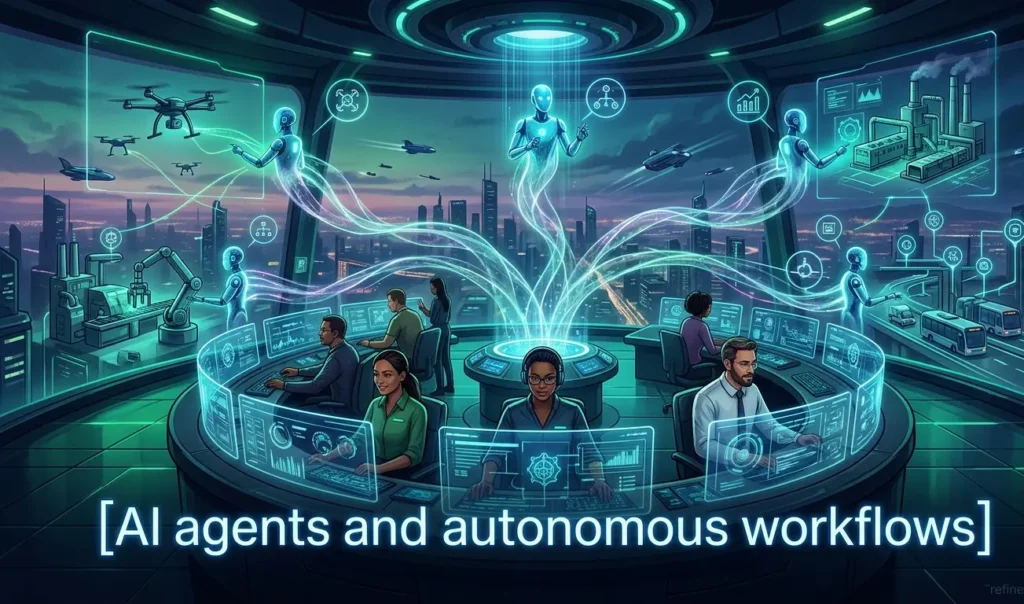
One major development in business AI is the movement from simple prompts toward AI agents capable of completing multiple steps.
A traditional AI assistant may answer a question.
An agent-based workflow could potentially:
- Receive a customer request
- Understand the request
- Retrieve relevant information
- Check a business system
- Prepare an action
- Ask for approval when necessary
- Update the relevant system
- Record the completed activity
This model could make AI much more valuable to businesses because it connects intelligence with execution.
At the same time, autonomous systems require stronger controls. Businesses need permissions, monitoring, logging, security policies, and human escalation mechanisms.
benefits of ai for modern businesses
When implemented correctly, AI can create value across multiple areas.
improved productivity
Employees can spend less time on repetitive administrative work and more time on activities requiring creativity, communication, and judgment.
faster decision-making
AI can help organize and analyze information so business teams can reach insights more quickly.
better customer experiences
AI-powered support and personalization can make customer interactions faster and more relevant.
operational scalability
Automation can allow a company to handle higher volumes without increasing manual workload at the same rate.
improved knowledge access
Employees can find information more efficiently when business knowledge is organized and made searchable through intelligent systems.
reduced repetitive work
Automating predictable tasks can reduce the amount of time employees spend copying data between systems or performing routine actions.
challenges businesses should consider before adopting ai
AI is not automatically beneficial. Poor implementation can create new problems.
data quality
AI systems depend heavily on the information they receive. Incorrect, incomplete, or outdated data can lead to unreliable results.
security and privacy
Businesses should understand what information is being sent to AI systems and how that information is stored or processed.
Sensitive business information should receive appropriate protection.
integration complexity
An AI tool may look impressive in isolation but become difficult to use when it needs to communicate with existing CRM, ERP, accounting, support, or internal systems.
employee adoption
Employees need to understand how AI fits into their responsibilities. A technically successful system can still fail if employees do not trust or use it.
inaccurate outputs
Generative AI can produce incorrect information. Important business decisions should therefore include appropriate verification and human oversight.
unclear return on investment
Businesses should establish measurable goals before investing heavily in AI.
The question should always be: What business outcome will this technology improve?
droven.io vs traditional ai tool research
Droven.io can be viewed as part of the research stage that comes before implementation.
| Factor | General AI tool search | Droven.io-oriented research |
|---|---|---|
| Primary focus | Finding software | Understanding AI concepts and applications |
| Starting point | Product or tool | Technology and business problem |
| Main audience | Tool buyers | Businesses, professionals, learners, and decision-makers |
| Approach | Compare products | Understand categories and use cases |
| Automation perspective | Tool-focused | Workflow-focused |
| Digital transformation | Often secondary | Broader technology context |
| Implementation | Usually outside the research | Requires separate technical planning |
| Best use | Finding possible solutions | Building knowledge before making decisions |
This distinction matters because researching technology and implementing technology are two different stages.
A business can use educational resources to understand its options and then conduct a deeper technical assessment before deployment.
a practical ai adoption framework for businesses
A structured approach can make AI adoption easier.
step 1: identify the business problem
Start with a measurable problem instead of an AI product.
For example, if employees spend 20 hours each week manually processing documents, document automation may be worth investigating.
step 2: map the existing workflow
Document what currently happens from beginning to end.
Identify:
- Manual steps
- Repeated tasks
- Data sources
- Software systems
- Approval points
- Common errors
- Delays
step 3: identify the ai opportunity
Determine which parts of the workflow could benefit from AI and which should remain manual.
step 4: evaluate data and integration
Check whether the required information can be securely accessed and whether the AI system can connect with existing business applications.
step 5: start with a controlled pilot
Instead of transforming the entire company immediately, begin with one process.
A smaller pilot makes it easier to identify problems and calculate results.
step 6: measure performance
Compare the new process with the old one.
Useful measurements include:
- Time saved
- Cost per task
- Error rate
- Customer response time
- Employee adoption
- Revenue impact
- Conversion rate
step 7: expand carefully
Once the pilot demonstrates measurable value, the business can gradually expand AI into other workflows.
common mistakes businesses make with ai
AI adoption can fail when companies focus more on technology than outcomes.
Common mistakes include:
- Buying tools without identifying a business problem
- Automating a broken process
- Ignoring data quality
- Failing to train employees
- Expecting AI to be completely autonomous
- Choosing tools without considering integrations
- Ignoring security requirements
- Measuring activity instead of business outcomes
- Deploying too many AI tools simultaneously
- Failing to establish human oversight
A smaller, well-defined AI project is often more useful than a large implementation with no measurable objective.
who can benefit from droven.io ai for business?
The subject is relevant to several types of organizations and professionals.
startups
Startups can use AI knowledge to identify opportunities for automation and build efficient workflows from an early stage.
small businesses
Small businesses can investigate AI for customer service, marketing, administration, lead management, and internal operations.
growing companies
As organizations grow, manual processes often become difficult to manage. AI and automation can help address repetitive workloads.
enterprise teams
Large organizations can explore AI across departments while paying particular attention to governance, security, integration, and scalability.
business professionals
Managers and decision-makers can use AI knowledge to better understand technology discussions and evaluate potential business applications.
what makes an ai strategy successful?
Technology alone does not determine whether an AI project succeeds.
A strong strategy combines several elements:
- Clear business objectives
- Reliable data
- Appropriate technology
- Strong integration
- Employee participation
- Security controls
- Human oversight
- Measurable KPIs
- Continuous improvement
The most successful organizations are likely to treat AI as an ongoing capability rather than a one-time software purchase.
frequently asked questions
what is droven.io ai for business?
Droven.io AI for business refers to using AI-related knowledge, automation concepts, and emerging technology insights to understand and improve business processes. Droven.io is positioned as an educational technology knowledge platform rather than a single AI software product.
is droven.io an ai software product?
Droven.io is presented primarily as an AI and technology knowledge resource. Its subject areas include artificial intelligence, automation, RPA, machine learning, cloud computing, cybersecurity, and related technologies.
how can businesses use ai?
Businesses can use AI for customer support, sales, marketing, document processing, internal knowledge management, data analysis, workflow automation, and other repetitive or information-heavy processes.
what is drovenio ai in digital transformation?
Drovenio AI in digital transformation describes the role AI can play within a broader modernization strategy. Rather than using AI as an isolated tool, businesses can integrate it with workflows, data, cloud systems, software, and employee processes.
is ai useful for startups?
Yes. Startups can use AI to automate repetitive work, improve customer interactions, analyze information, and create new technology products. However, startups should prioritize real customer problems instead of adopting AI simply because it is trending.
what is the future of ai for businesses?
The future is likely to involve deeper integration between AI and existing business systems. AI agents, intelligent workflows, knowledge systems, predictive analytics, and human-AI collaboration are important areas businesses can monitor as the technology develops.
should every business adopt ai?
Not necessarily. AI is most valuable when it solves a real business problem and produces measurable benefits. Some processes can be improved more effectively through conventional automation, better software, or process redesign.
conclusion
Droven.io AI for business reflects a broader shift in how organizations should approach artificial intelligence. The most important question is no longer whether AI exists or whether a company should experiment with it. The more useful question is where AI can solve a genuine business problem and produce measurable value.
Droven.io provides a technology-focused knowledge perspective covering AI, automation, machine learning, cloud computing, cybersecurity, and digital transformation. That makes the subject useful for businesses that want to understand their options before moving into implementation.
For startups, small businesses, and larger organizations, the strongest AI strategy begins with a clear process, reliable data, measurable objectives, and appropriate human oversight. Businesses that approach AI as part of a broader digital transformation strategy can make more informed technology decisions and avoid the common mistake of purchasing tools without understanding how they fit into everyday operations.
The future of AI is therefore not simply about using more artificial intelligence. It is about using it more intelligently—connecting technology with people, processes, data, and measurable business outcomes.