DevOps can feel confusing when you first enter the field. You hear about Linux, Git, Docker, Jenkins, Kubernetes, Terraform, AWS, monitoring, automation, and dozens of other technologies, but it is rarely clear which one you should learn first.
That is why people searching for droven. io devops tutorials usually need more than individual tool explanations. They need a structured learning path showing how development, testing, infrastructure, deployment, monitoring, and automation work together.
The best way to learn DevOps is not to memorize every available tool. Instead, understand the complete software delivery process and gradually introduce automation into it.
This guide explains the fundamental concepts, technologies, workflows, projects, and learning order you need to build practical DevOps skills.
Table of Contents
What Are Droven.io DevOps Tutorials?
Droven.io DevOps tutorials can be understood as educational resources related to DevOps practices, software delivery, automation, cloud computing, infrastructure management, and system administration.
DevOps itself is not a programming language or a single technology. It is an approach that brings software development and IT operations closer together.
A modern DevOps workflow commonly includes:
- Source code management
- Automated software testing
- Continuous Integration
- Continuous Delivery or Deployment
- Containerization
- Infrastructure automation
- Cloud computing
- Configuration management
- Monitoring and observability
- Security automation
- Incident response
Instead of treating these areas separately, DevOps connects them into a repeatable software delivery process.
How DevOps Works in a Real Development Environment
Imagine that a development team creates a web application.
Without DevOps automation, developers might manually upload new code to a server whenever an update is ready. Someone may need to configure the server manually, run tests, restart services, and check whether everything still works.
This process becomes difficult as applications and teams grow.
A DevOps workflow improves the process.
A developer can:
- Write or update application code.
- Push the code to a Git repository.
- Trigger automated tests.
- Build the application automatically.
- Create a container image.
- Deploy it to a testing environment.
- Run security and quality checks.
- Deploy the approved version to production.
- Monitor the application continuously.
Each stage can be automated, making deployments more consistent and easier to repeat.
Why Learning DevOps Requires More Than Learning Tools
One of the biggest mistakes beginners make is creating a list of tools and trying to master all of them individually.
For example:
- Git
- GitHub
- Jenkins
- Docker
- Kubernetes
- Terraform
- Ansible
- AWS
- Prometheus
- Grafana
Knowing what these tools do is useful, but DevOps engineers need to understand why and where each tool belongs in a software delivery workflow.
Consider Docker.
Learning Docker commands is helpful, but practical knowledge means understanding:
- Why containers are used
- How Docker images are created
- How containers communicate
- How applications store persistent data
- How environment variables work
- How container images are deployed
- How containers fit into CI/CD pipelines
The same principle applies to every DevOps technology.
The Best DevOps Learning Order for Beginners
A structured sequence makes learning much easier.
1. Learn Linux Fundamentals
Linux should be one of your first priorities because many servers, containers, cloud systems, and automation environments rely heavily on Linux.
Start with:
- Linux file system
- Files and directories
- Users and groups
- File permissions
- Processes
- Services
- Package managers
- SSH
- Environment variables
- Networking commands
- Log files
- Bash basics
Practice commands such as:
- ls
- cd
- mkdir
- cp
- mv
- rm
- cat
- grep
- chmod
- chown
- ps
- top
- systemctl
- ssh
You do not need to become a Linux administrator before continuing. You should simply become comfortable working through the terminal.
2. Understand Networking Basics
DevOps engineers frequently troubleshoot applications that communicate across networks.
Important concepts include:
- IP addresses
- DNS
- Ports
- TCP and UDP
- HTTP and HTTPS
- Firewalls
- Load balancers
- Reverse proxies
- Domain names
- SSL/TLS
- Private and public networks
For example, when an application cannot connect to a database, the problem might not be in the application itself. It could involve DNS, network rules, ports, credentials, or firewall configuration.
Understanding networking makes troubleshooting much easier.
3. Learn Git and Version Control
Git is one of the foundations of modern software development and DevOps.
You should understand:
- Repository
- Commit
- Branch
- Merge
- Clone
- Pull
- Push
- Remote repository
- Merge conflicts
- Pull requests
- Tags
- Release branches
A simple workflow may look like this:
Developer writes code → commits changes → pushes changes → pull request is reviewed → changes are merged → CI pipeline starts.
Git is not only used for application code. DevOps teams also store infrastructure definitions, configuration files, Kubernetes manifests, and pipeline configurations in Git repositories.
Continuous Integration and Continuous Delivery
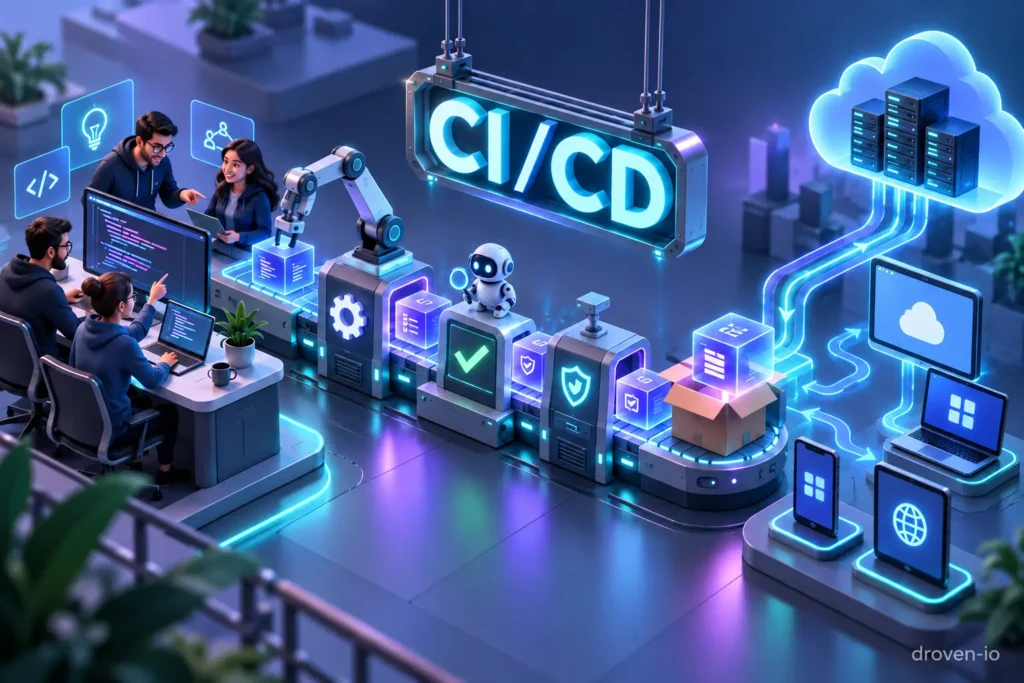
CI/CD is one of the most important concepts covered when learning through droven. io devops tutorials and other DevOps resources.
What Is Continuous Integration?
Continuous Integration means developers frequently integrate their code into a shared repository while automated processes verify those changes.
A CI pipeline might:
- Download the latest code
- Install dependencies
- Check code quality
- Run unit tests
- Run security scans
- Build the application
- Create an artifact or container image
If something fails, the pipeline stops and reports the problem.
What Is Continuous Delivery?
Continuous Delivery prepares software so it can be released reliably whenever the team decides to deploy it.
What Is Continuous Deployment?
Continuous Deployment goes further by automatically releasing approved changes into production after the required pipeline checks pass.
Popular CI/CD Technologies
Common options include:
- Jenkins
- GitHub Actions
- GitLab CI/CD
- Azure Pipelines
- CircleCI
Do not try to learn every platform immediately. Learn the concepts with one tool first.
Docker and Containerization
Containers solved an important software deployment problem: applications often behave differently across environments.
A developer might say:
“It works on my machine.”
The production server may have different dependencies, software versions, or configurations.
Docker packages the application and its required environment into a container image.
Important Docker Concepts
Learn:
- Docker images
- Containers
- Dockerfile
- Image layers
- Volumes
- Networks
- Ports
- Environment variables
- Docker Compose
- Container registries
A basic Docker workflow looks like:
Application code → Dockerfile → Docker image → container registry → server or Kubernetes cluster.
Docker Compose
Docker Compose becomes useful when an application requires several services.
For example:
- Web application
- Database
- Redis
- Background worker
Instead of starting each service manually, a Compose configuration can define and start the complete environment.
Kubernetes and Container Orchestration
Docker can run containers, but managing hundreds of containers across multiple servers creates another challenge.
Kubernetes helps automate container orchestration.
It can handle:
- Container scheduling
- Application scaling
- Service discovery
- Load balancing
- Rolling updates
- Self-healing
- Configuration management
- Secret management
Kubernetes Concepts Beginners Should Learn
Start with:
- Cluster
- Node
- Pod
- Deployment
- ReplicaSet
- Service
- ConfigMap
- Secret
- Namespace
- Ingress
- Persistent Volume
Do not begin your DevOps journey with Kubernetes.
Learn Linux, networking, Git, containers, and basic deployment concepts first. Kubernetes becomes much easier once you understand the problems it is designed to solve.
Infrastructure as Code With Terraform
Traditional infrastructure may be created manually from a cloud dashboard.
For example, an engineer could manually create:
- Virtual machines
- Networks
- Databases
- Load balancers
- Security rules
The problem is repeatability.
If the same infrastructure needs to be created again, every configuration has to be remembered.
Infrastructure as Code solves this problem by defining infrastructure through configuration files.
What Terraform Does
Terraform can describe infrastructure such as:
- Virtual machines
- Virtual networks
- Subnets
- Storage
- Databases
- Load balancers
- DNS resources
- Cloud services
Important Terraform concepts include:
- Providers
- Resources
- Variables
- Outputs
- State
- Modules
- Plan
- Apply
- Destroy
The major idea is simple: infrastructure becomes version-controlled and repeatable.
Configuration Management With Ansible
Terraform and Ansible are sometimes confused because both support automation.
Their primary purposes are different.
Terraform is commonly associated with provisioning infrastructure.
Ansible is commonly used for configuring systems and automating operational tasks.
For example, Terraform might create five virtual machines.
Ansible might then:
- Install software
- Create users
- Configure services
- Update configuration files
- Start applications
Important Ansible concepts include:
- Inventory
- Playbooks
- Tasks
- Roles
- Modules
- Variables
- Handlers
DevOps Tool Comparison
| Area | Popular Tools | Main Purpose | Beginner Priority |
|---|---|---|---|
| Version Control | Git, GitHub, GitLab | Manage and track code changes | Very High |
| CI/CD | Jenkins, GitHub Actions, GitLab CI/CD | Automate builds, tests, and deployments | Very High |
| Containers | Docker | Package and run applications consistently | Very High |
| Orchestration | Kubernetes | Manage containers at scale | Medium |
| Infrastructure as Code | Terraform | Provision infrastructure through code | High |
| Configuration Management | Ansible | Automate server configuration | Medium |
| Cloud | AWS, Azure, Google Cloud | Provide infrastructure and managed services | High |
| Monitoring | Prometheus, Grafana | Track system health and performance | High |
| Logging | ELK Stack, Loki | Collect and analyze logs | Medium |
| GitOps | Argo CD, Flux | Manage deployments through Git | Advanced |
This comparison also shows why learning everything at once is unnecessary. Each technology solves a different problem.
Cloud Computing for DevOps
Cloud platforms are closely connected with modern DevOps practices.
The three major cloud ecosystems commonly encountered are:
- Amazon Web Services
- Microsoft Azure
- Google Cloud
Beginners do not need to learn all three simultaneously.
Choose one platform and understand fundamental concepts such as:
- Virtual machines
- Virtual networks
- Object storage
- Databases
- Identity and access management
- Load balancing
- Auto scaling
- DNS
- Containers
- Serverless computing
Once you understand the architecture on one major cloud platform, many underlying concepts transfer to others.
Monitoring, Logging, and Observability
Deployment is not the end of the DevOps lifecycle.
After releasing an application, teams need to understand how it behaves.
Monitoring can answer questions such as:
- Is the application online?
- Is CPU usage unusually high?
- Is memory running out?
- Are requests becoming slower?
- Are users receiving errors?
Metrics
Metrics provide numerical information about system behavior.
Examples include:
- CPU utilization
- Memory consumption
- Request count
- Error rate
- Response time
Prometheus is commonly associated with metrics collection, while Grafana is widely used to visualize data through dashboards.
Logs
Logs provide detailed records of events generated by applications and infrastructure.
Good logging helps engineers investigate failures and unexpected behavior.
Traces
Distributed tracing becomes particularly useful with microservices because one user request may travel through several services.
Logs, metrics, and traces together provide much stronger visibility than any one of them alone.
DevSecOps: Adding Security to the DevOps Workflow
Security should not be treated as a final check performed immediately before deployment.
DevSecOps introduces security earlier in the software delivery lifecycle.
A secure pipeline may include:
- Dependency scanning
- Static code analysis
- Container image scanning
- Secret detection
- Infrastructure scanning
- Access control checks
- Vulnerability scanning
Security automation helps identify problems earlier, when they are usually easier to fix.
Never Store Secrets Directly in Source Code
Sensitive information such as the following should be managed securely:
- API keys
- Database passwords
- Access tokens
- Private keys
- Cloud credentials
Secret management becomes increasingly important as infrastructure and deployment automation grows.
GitOps and Modern Deployment Practices
After learning traditional CI/CD, you may encounter GitOps.
GitOps uses Git repositories as a source of truth for application and infrastructure configuration.
Instead of manually changing a Kubernetes environment, teams update configuration stored in Git.
A GitOps tool can then synchronize the environment with the desired configuration.
This approach can improve:
- Traceability
- Version history
- Rollback capabilities
- Configuration consistency
- Deployment automation
Argo CD and Flux are examples of technologies associated with GitOps workflows.
GitOps is valuable, but beginners should understand Git, CI/CD, Docker, and Kubernetes before exploring it deeply.
Site Reliability Engineering and DevOps
DevOps and Site Reliability Engineering are closely related but not identical.
DevOps focuses heavily on culture, collaboration, automation, and software delivery.
SRE applies software engineering approaches to system reliability and operations.
Important SRE concepts include:
- Service Level Indicators
- Service Level Objectives
- Service Level Agreements
- Error budgets
- Incident management
- Reliability engineering
Understanding these concepts becomes valuable when moving from basic deployments to production systems serving real users.
A Practical DevOps Project for Beginners
Reading tutorials is useful, but projects turn individual concepts into practical knowledge.
One strong beginner project is deploying a simple web application through an automated pipeline.
Step 1: Create a Small Application
Use a basic application built with technology such as:
- Node.js
- Python
- PHP
- Java
The application itself does not need to be complicated.
Step 2: Store the Project in Git
Create a repository and practice:
- Commits
- Branches
- Pull requests
- Merging
Step 3: Add Automated Testing
Create a CI workflow that runs whenever code is pushed.
The pipeline should at least verify that the application builds successfully.
Step 4: Dockerize the Application
Create a Dockerfile and build an application image.
Run it locally before continuing.
Step 5: Push the Image to a Registry
Store your container image in a registry so another environment can retrieve it.
Step 6: Deploy the Application
Initially, deploy it to a virtual machine.
This teaches you how servers, ports, networking, processes, and deployments work.
Step 7: Automate Infrastructure
Use Terraform to provision the infrastructure instead of manually creating it.
Step 8: Automate Configuration
Use Ansible or another configuration management approach to prepare the server.
Step 9: Add Monitoring
Track application and server performance.
Step 10: Introduce Kubernetes
Once the simpler deployment works, deploy the containerized application to Kubernetes.
By completing one project like this, you experience how different DevOps technologies connect.
A Complete DevOps Workflow Example
After learning the individual technologies, the entire process may look like this:
Developer
↓
Git repository
↓
CI pipeline
↓
Automated tests
↓
Security checks
↓
Docker image build
↓
Container registry
↓
Infrastructure provisioned with Terraform
↓
Deployment to cloud or Kubernetes
↓
Monitoring and logging
↓
Alerts and incident response
Understanding this workflow is more valuable than memorizing a long list of DevOps tools.
Common Mistakes When Learning DevOps
People following droven. io devops tutorials or any other DevOps learning resources should avoid several common mistakes.
Trying to Learn Every Tool
DevOps has hundreds of technologies.
You do not need all of them.
Learn one tool for each important category and understand the concepts behind it.
Starting With Kubernetes Too Early
Kubernetes receives a lot of attention, but beginners can easily become overwhelmed by it.
Learn containers first.
Ignoring Linux
A graphical interface can hide many important system concepts.
Become comfortable using the Linux command line.
Watching Tutorials Without Practicing
You can watch hours of Docker tutorials without developing practical Docker skills.
Type commands yourself.
Break environments.
Fix them.
That process develops troubleshooting ability.
Memorizing Commands
Knowing commands is less important than knowing what problem you are trying to solve.
Documentation can remind you of syntax.
Understanding architecture requires actual practice.
Ignoring Networking
Many apparent Docker, Kubernetes, and cloud problems are actually networking problems.
Learn the fundamentals early.
Building Projects That Are Too Complicated
Start small.
A basic web application deployed through an automated CI/CD pipeline can teach more than an unfinished enterprise-level project.
How to Troubleshoot DevOps Problems
Troubleshooting is one of the most important DevOps skills.
When something fails, avoid randomly changing configurations.
Use a structured approach.
Identify the Exact Failure
Determine which stage failed:
- Application
- Pipeline
- Container
- Network
- Infrastructure
- Authentication
- Database
- Deployment
Read the Error Message
Error messages often contain the most useful clue.
Do not immediately copy the error and search for a solution without first understanding what it says.
Check Logs
Logs can show:
- Application errors
- Authentication failures
- Network failures
- Service crashes
- Resource limitations
Verify Configuration
Check:
- Environment variables
- Credentials
- Port numbers
- Hostnames
- File permissions
- Network rules
Reproduce the Problem
If possible, recreate the issue in a test environment.
Reproducible failures are generally much easier to diagnose.
Skills You Should Have Before Calling Yourself Job Ready
There is no single checklist that guarantees a DevOps job, but a beginner should ideally be comfortable with the following areas.
Linux
You can navigate, manage files, inspect processes, work with services, and read logs.
Git
You understand repositories, branches, commits, merges, and pull requests.
Networking
You understand IP addresses, DNS, ports, HTTP, HTTPS, and basic network troubleshooting.
Scripting
You can automate simple tasks using Bash or Python.
CI/CD
You can create a basic automated build, test, and deployment workflow.
Docker
You can containerize an application and work with images, containers, networks, and volumes.
Cloud
You can deploy an application using at least one cloud platform.
Infrastructure as Code
You understand how Terraform or a similar technology manages infrastructure declaratively.
Kubernetes
You understand basic container orchestration and can deploy a small application.
Monitoring
You know how to check metrics, logs, application health, and alerts.
More importantly, you should be able to explain how these skills connect.
Beginner to Advanced DevOps Roadmap
A simple roadmap can be divided into four stages.
Foundation
Learn:
- Linux
- Networking
- Git
- GitHub
- Bash
- Basic programming
Core DevOps
Learn:
- CI/CD
- Jenkins or GitHub Actions
- Docker
- Cloud fundamentals
- Terraform
- Ansible
Container and Production Skills
Move into:
- Kubernetes
- Helm
- Monitoring
- Logging
- Secrets management
- Cloud networking
Advanced DevOps
Explore:
- GitOps
- Argo CD
- DevSecOps
- SRE
- Platform engineering
- Advanced Kubernetes
- High availability
- Disaster recovery
- Cost optimization
This structure provides a much clearer direction than attempting to study tools randomly.
How to Get More Value From Droven.io DevOps Tutorials
When studying through droven. io devops tutorials, or any similar technical learning material, use each tutorial as part of a larger hands-on project.
After reading about a technology:
- Understand the problem it solves.
- Install or configure it yourself.
- Complete a simple example.
- Break the setup intentionally.
- Troubleshoot the failure.
- Add the technology to a larger project.
- Document what you learned.
This turns passive reading into practical experience.
Maintaining your own notes also helps. Record important commands, architecture diagrams, errors you encountered, and how you solved them.
Frequently Asked Questions
What are droven. io devops tutorials?
The term generally refers to people looking for DevOps learning content connected with Droven.io, including subjects such as automation, CI/CD, containers, cloud computing, infrastructure management, monitoring, and modern software delivery practices.
Are DevOps tutorials suitable for complete beginners?
Yes. Beginners can learn DevOps, but they should start with foundational technologies such as Linux, networking, Git, and basic scripting before progressing to Docker, CI/CD, cloud platforms, Terraform, and Kubernetes.
Do I need programming knowledge to learn DevOps?
You do not need advanced software development skills, but basic programming or scripting knowledge is extremely useful. Bash and Python are commonly useful for automating tasks and understanding deployment workflows.
Which DevOps tool should I learn first?
Start with Git after learning basic Linux and networking concepts. Git is used throughout modern software development and becomes important when you later work with CI/CD, Infrastructure as Code, GitOps, and Kubernetes configurations.
Should I learn Docker before Kubernetes?
Yes. Kubernetes orchestrates containers, so understanding Docker or container concepts first makes Kubernetes much easier to understand.
Which cloud platform is best for beginners in DevOps?
AWS, Microsoft Azure, and Google Cloud can all be used for DevOps. Instead of trying to learn all of them, choose one platform and first understand core cloud concepts such as virtual machines, networks, storage, identity, databases, and load balancing.
Conclusion
Droven. io DevOps tutorials can serve as a starting point for understanding the technologies and practices behind modern software delivery, but learning DevOps effectively requires more than reading definitions or memorizing commands.
Start with the fundamentals. Learn Linux, networking, Git, and basic scripting. Then move into CI/CD, Docker, cloud computing, Terraform, configuration management, Kubernetes, monitoring, and security.
Most importantly, connect everything through real projects.
A DevOps engineer does not need to know every technology available. What matters is understanding how software moves from source code to a reliable production environment, how that process can be automated, and how problems can be identified and resolved when something goes wrong.
Once you understand that complete workflow, individual DevOps tools become much easier to learn and apply.