Introduction
Artificial intelligence has become a driving force behind modern business transformation, enabling organizations to streamline workflows, reduce operational costs, and improve decision-making. Among the growing number of AI-powered platforms, Droven IO AI automation tools have gained attention for helping businesses automate repetitive tasks while increasing efficiency across multiple departments.
Whether you’re a startup, a growing company, or an enterprise looking to modernize operations, AI automation is no longer a luxury—it’s a necessity. Businesses today are adopting intelligent automation to handle customer support, workflow management, data processing, document handling, reporting, and much more.
This guide explores everything you need to know about Droven IO AI automation tools, including their features, applications, benefits, automation capabilities, and how they compare with traditional business processes. We’ll also examine the platform’s role in the future of AI, discuss droven.io reviews, explore droven.io RPA and business automation, and explain why many consider it among the emerging droven.io AI startup platforms shaping intelligent business solutions.
What Are Droven IO AI Automation Tools?
Droven IO AI automation tools refer to a collection of AI-powered technologies designed to automate business operations, eliminate repetitive manual work, and improve organizational productivity.
Instead of relying solely on human intervention for routine processes, AI-driven automation uses machine learning, intelligent algorithms, workflow automation, and predictive analytics to perform tasks accurately and efficiently.
These tools help businesses:
- Automate repetitive workflows
- Process large datasets quickly
- Generate reports automatically
- Improve customer interactions
- Optimize internal operations
- Reduce human errors
- Increase employee productivity
- Speed up decision-making
Unlike conventional automation software, AI-powered automation continuously learns from data, making workflows smarter over time.
Why Businesses Are Investing in AI Automation
Organizations across industries are embracing AI because automation provides measurable improvements in productivity and operational efficiency.
Some of the biggest reasons include:
Reduced Manual Work
Routine administrative tasks consume valuable employee time. AI automation minimizes repetitive work, allowing teams to focus on innovation and strategic planning.
Improved Accuracy
Manual data entry often results in costly errors. AI systems process information consistently while reducing mistakes.
Faster Decision Making
AI analyzes large amounts of information within seconds, enabling businesses to make informed decisions much faster.
Cost Optimization
Automation reduces operational expenses by minimizing repetitive labor and improving workflow efficiency.
Better Customer Experience
AI-powered assistants can provide faster responses, personalized recommendations, and 24/7 customer support.
Key Features of Droven IO AI Automation Tools
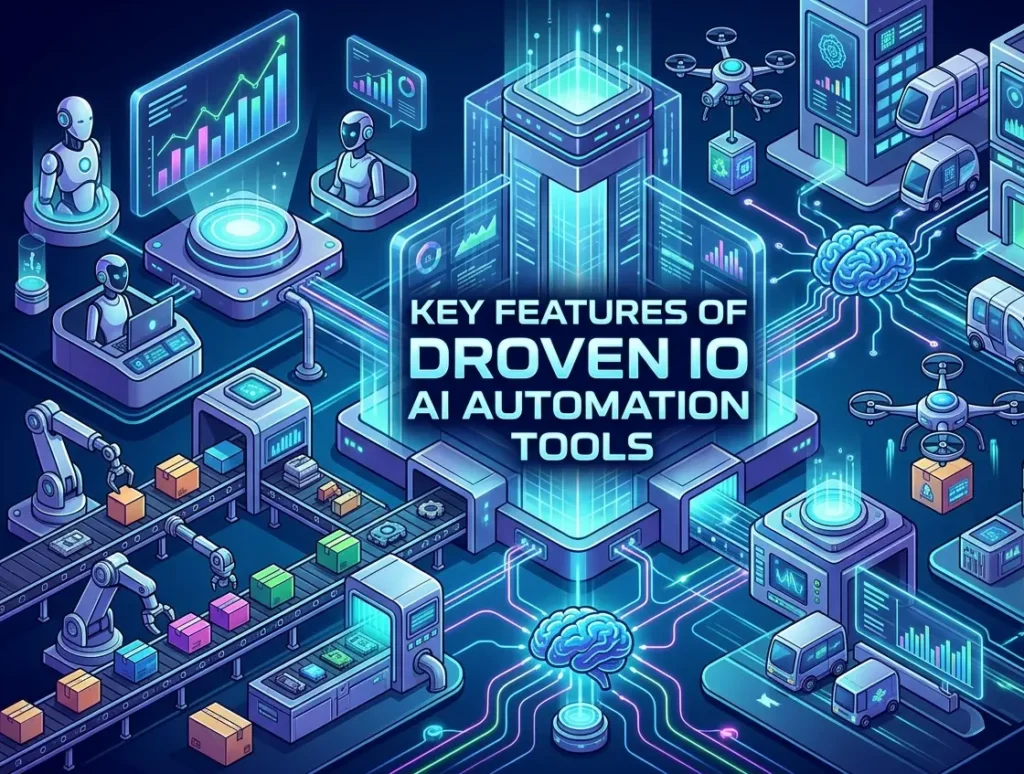
One reason businesses are exploring Droven IO AI automation tools is the broad range of automation capabilities available for different operational needs.
Intelligent Workflow Automation
Workflow automation helps eliminate repetitive processes by automatically moving tasks between departments.
Examples include:
- Employee onboarding
- Invoice approvals
- Purchase requests
- Internal notifications
- Task assignment
- Project tracking
Instead of waiting for manual approvals, workflows move automatically based on predefined rules and AI recommendations.
AI-Powered Data Processing
Modern businesses generate enormous amounts of information every day.
AI automation can:
- Organize business records
- Extract important information
- Categorize documents
- Identify patterns
- Detect anomalies
- Generate insights automatically
This saves countless hours that would otherwise be spent manually reviewing information.
Predictive Analytics
Predictive AI helps businesses prepare for future outcomes by analyzing historical data.
Common applications include:
- Sales forecasting
- Inventory planning
- Customer behavior prediction
- Marketing optimization
- Financial planning
- Risk assessment
Predictive analytics allows organizations to make proactive decisions instead of reacting after problems occur.
Smart Document Automation
Document management is another area where automation creates significant value.
Businesses can automate:
- Invoice processing
- Contracts
- Employee documents
- Reports
- Financial records
- Compliance documentation
AI recognizes document types, extracts important information, and routes files to the correct department automatically.
Business Intelligence Integration
Many organizations rely on dashboards and analytics for decision-making.
AI automation improves reporting by:
- Collecting business metrics
- Creating visual dashboards
- Updating reports automatically
- Highlighting unusual trends
- Recommending actions
Executives gain real-time visibility without manually compiling spreadsheets.
How Droven IO AI Startup Is Supporting Digital Transformation
The growing interest in droven.io AI startup solutions reflects the increasing demand for intelligent business platforms that combine automation with practical AI applications.
Instead of replacing employees, AI automation focuses on enhancing productivity by handling repetitive tasks while allowing teams to concentrate on creative problem-solving and strategic work.
Organizations adopting AI automation often experience:
- Faster project completion
- Improved collaboration
- Higher operational consistency
- Better resource allocation
- Increased employee satisfaction
- More scalable business processes
As AI technology continues evolving, startups focused on automation are playing an increasingly important role in helping businesses modernize.
Droven.io RPA and Business Automation Explained
One area receiving significant attention is droven.io RPA and business automation.
Robotic Process Automation (RPA) focuses on automating repetitive rule-based tasks that traditionally require manual effort.
Examples include:
- Copying data between systems
- Updating customer records
- Processing invoices
- Sending notifications
- Generating reports
- Scheduling repetitive workflows
When RPA combines with artificial intelligence, automation becomes much more powerful.
Instead of simply following programmed instructions, AI-enhanced automation can:
- Understand documents
- Interpret customer requests
- Learn from previous actions
- Improve workflow recommendations
- Handle more complex scenarios
This combination creates intelligent automation capable of supporting both operational efficiency and business growth.
Industries That Benefit from AI Automation
Nearly every industry can improve efficiency through intelligent automation.
Healthcare
Healthcare organizations automate:
- Appointment scheduling
- Patient record management
- Medical documentation
- Insurance processing
- Administrative workflows
This allows healthcare professionals to spend more time focusing on patient care.
Financial Services
Banks and financial institutions use AI automation for:
- Fraud detection
- Loan processing
- Customer verification
- Risk analysis
- Compliance reporting
- Transaction monitoring
Automation improves both speed and regulatory compliance.
Retail and E-commerce
Retail businesses leverage AI to optimize:
- Inventory management
- Product recommendations
- Customer service
- Order tracking
- Demand forecasting
- Pricing strategies
These improvements enhance customer satisfaction while reducing operational costs.
Manufacturing
Manufacturers implement AI automation for:
- Production monitoring
- Equipment maintenance
- Supply chain optimization
- Quality inspection
- Inventory control
- Predictive maintenance
The result is improved efficiency and reduced downtime.
Human Resources
HR departments automate numerous repetitive processes, including:
- Resume screening
- Candidate communication
- Employee onboarding
- Attendance tracking
- Payroll support
- Performance reporting
Automation significantly reduces administrative workload.
Advantages of Using AI Automation in Modern Businesses
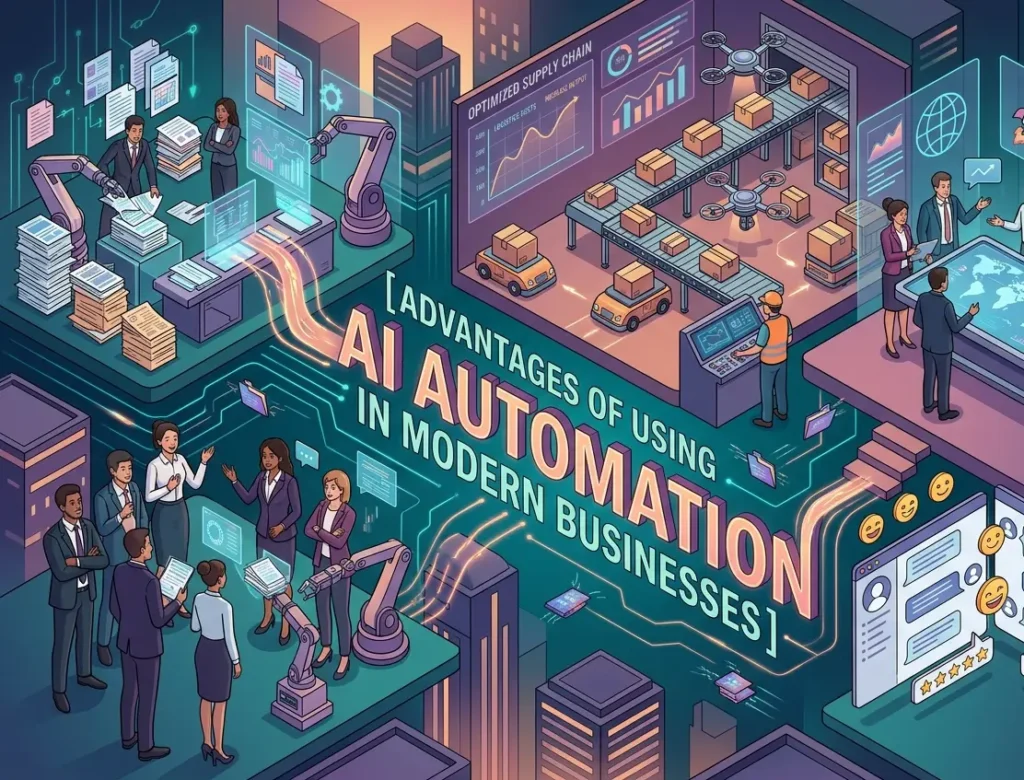
Organizations adopting intelligent automation often experience improvements across multiple business functions.
Some of the most significant advantages include:
- Increased productivity
- Faster workflows
- Lower operational expenses
- Better customer experiences
- Improved data accuracy
- Enhanced reporting capabilities
- Reduced manual intervention
- Better scalability
- Stronger compliance management
- Higher employee efficiency
Rather than replacing human expertise, AI enables employees to focus on tasks requiring creativity, strategy, and critical thinking.
AI Automation vs Traditional Business Processes
| Feature | AI Automation | Traditional Processes |
|---|---|---|
| Speed | Real-time processing | Manual and slower |
| Accuracy | High with continuous learning | Prone to human error |
| Scalability | Easily scales with business growth | Requires additional workforce |
| Cost Efficiency | Lower long-term operational costs | Higher recurring labor costs |
| Data Analysis | Instant insights and predictions | Time-consuming manual analysis |
| Availability | 24/7 automated operations | Limited by working hours |
Droven.io Reviews: What Businesses Look For in an AI Automation Platform
When evaluating any AI platform, decision-makers often search for droven.io reviews to understand how well the solution performs in real business environments. While every organization has unique requirements, businesses generally assess AI automation platforms based on a common set of factors.
These evaluation criteria include:
- Ease of implementation
- User-friendly interface
- Automation flexibility
- Integration with existing software
- Scalability for growing businesses
- Security and data protection
- Customer support
- Performance consistency
- Workflow customization
- Return on investment (ROI)
Rather than focusing only on features, companies also consider how quickly an automation platform can deliver measurable improvements. A solution that saves time, reduces manual work, and supports long-term business growth is often viewed more favorably than one with a long list of complex features.
Organizations typically begin with automating a few repetitive workflows before expanding automation across departments. This gradual approach helps teams adapt while maximizing the benefits of AI-powered operations.
Droven.io Best AI Startups in USA: Why AI Startups Are Driving Innovation
The conversation around droven.io best AI startups in USA reflects a broader trend in the technology industry. AI startups are introducing faster, more flexible solutions that help businesses adopt intelligent automation without the complexity of traditional enterprise software.
Several factors explain why AI-focused startups are attracting attention:
Faster Innovation
Smaller AI companies often release new features more quickly, responding to changing business needs and advancements in machine learning.
Flexible Solutions
Modern AI startups typically build cloud-based platforms that can scale from small businesses to large enterprises, making automation accessible to organizations of all sizes.
Industry-Specific Automation
Many AI startups design solutions tailored to industries such as healthcare, finance, retail, logistics, manufacturing, education, and customer service, allowing businesses to address unique operational challenges.
Continuous Improvement
AI systems learn from data over time, improving recommendations, recognizing patterns more accurately, and optimizing workflows without requiring constant manual adjustments.
Frequently Asked Questions
What are Droven IO AI automation tools?
Droven IO AI automation tools refer to AI-powered technologies that automate repetitive business processes, improve efficiency, support data analysis, and enhance workflow management.
How does AI automation improve business productivity?
AI automates routine tasks, reduces manual effort, minimizes errors, accelerates decision-making, and allows employees to focus on strategic initiatives.
What is the difference between AI automation and RPA?
RPA follows predefined rules to automate repetitive tasks, while AI automation can learn from data, recognize patterns, and make intelligent decisions. Combining both creates more advanced business automation.
Can small businesses benefit from AI automation?
Yes. Small businesses can use AI automation to improve customer support, streamline administrative work, automate reporting, and increase operational efficiency without significantly expanding their workforce.
Is AI automation replacing employees?
In most cases, AI is designed to assist employees rather than replace them. It handles repetitive tasks, allowing teams to concentrate on creative problem-solving, innovation, and customer engagement.
What industries benefit the most from AI automation?
Healthcare, finance, manufacturing, retail, education, logistics, customer service, marketing, and human resources are among the industries that benefit significantly from AI-powered automation.
Conclusion
The growing demand for Droven IO AI automation tools reflects a larger shift toward intelligent, data-driven business operations. Organizations are increasingly adopting AI to simplify repetitive workflows, improve productivity, enhance customer experiences, and make faster, more informed decisions.
As interest in droven.io AI startup solutions continues to grow, businesses are recognizing the value of combining artificial intelligence with droven.io RPA and business automation strategies to build scalable and efficient operations. Insights from droven.io reviews also highlight the importance of evaluating usability, flexibility, and long-term business impact when selecting an automation platform.
Looking ahead, the droven io future of AI points toward more adaptive systems capable of learning, optimizing, and supporting organizations across virtually every industry. Businesses that embrace intelligent automation today will be better positioned to innovate, remain competitive, and respond effectively to the evolving demands of the digital economy.