Enterprise technology is no longer limited to installing faster computers or moving files to the cloud. It now involves artificial intelligence, workflow automation, cybersecurity, data analytics, software development, and connected digital systems. Droven.io enterprise tech innovation brings these subjects together through practical articles, explainers, and technology insights.
Droven.io is an editorial technology platform rather than a software product or automation service. It helps readers understand emerging technologies, compare possible solutions, and explore how digital innovation can support business growth. This distinction is important because the platform provides information and guidance, but it does not directly deploy enterprise systems.
For business leaders, IT professionals, developers, marketers, and students, the platform can serve as a starting point for understanding complex technology before making strategic decisions.
Table of Contents
What Is Droven.io Enterprise Tech Innovation?
Droven.io enterprise tech innovation refers to the platform’s coverage of technologies and strategies used by organizations to modernize operations. Its content focuses on how businesses can apply digital tools to improve efficiency, security, customer experience, collaboration, and decision-making.
The main subjects associated with this coverage include:
- Artificial intelligence and machine learning
- Generative AI tools and applications
- Business process automation
- Cloud computing and cloud migration
- Cybersecurity and data privacy
- Big data and business analytics
- Software and web development
- Digital transformation
- Future-of-work technologies
- Emerging technology careers
- Innovation and entrepreneurship
Instead of presenting enterprise innovation as one tool, Droven.io explores it as a connected ecosystem. A company may use cloud infrastructure to store data, analytics software to study that data, AI to generate insights, and automation to act on those insights. Cybersecurity and governance then protect the entire environment.
Droven.io Is an Information Platform, Not an Enterprise Product
Some readers may assume Droven.io is an AI application, cloud service, or business automation platform. However, it is better understood as a technology publication and educational resource.
It does not appear to provide a single dashboard where businesses can create workflows, manage cloud servers, or deploy AI models. Instead, its role is to explain technologies, tools, business applications, and emerging trends.
This makes the platform useful during the research and planning stages of an enterprise technology project. Readers can use its content to develop a basic understanding of a subject before consulting technical specialists, comparing vendors, or testing software.
What Droven.io Can Help Readers Do
Droven.io content can help readers:
- Understand unfamiliar technology concepts
- Discover possible business applications for AI
- Learn how automation can improve repetitive workflows
- Explore cloud computing strategies
- Recognize cybersecurity and privacy risks
- Compare categories of digital tools
- Follow changes in software development
- Identify emerging technology trends
- Prepare better questions for vendors and consultants
What Droven.io Does Not Replace
An editorial platform cannot replace:
- A detailed enterprise technology audit
- Professional legal or compliance advice
- Cybersecurity testing
- Software implementation services
- Vendor-specific technical documentation
- Employee training
- Financial feasibility analysis
- A customized digital transformation strategy
Its information should support research rather than become the sole basis for an expensive technology decision.
Core Areas of Enterprise Technology Innovation
The value of enterprise innovation comes from connecting multiple technologies around a measurable business need. Droven.io explores several areas that contribute to this process.
Artificial Intelligence
Artificial intelligence helps organizations analyze information, recognize patterns, generate content, answer questions, and support decisions. Modern enterprise AI can be used in customer service, sales, finance, human resources, logistics, marketing, and software development.
Common applications include:
- AI-powered customer support assistants
- Document summarization
- Predictive maintenance
- Fraud detection
- Sales forecasting
- Personalized recommendations
- Internal knowledge search
- Automated content creation
- Quality control
A successful AI initiative needs reliable data, clear oversight, defined objectives, and human review. Purchasing an AI tool without addressing these requirements can create inaccurate outputs and unnecessary costs.
Workflow Automation
Automation removes repetitive manual steps from business processes. It can connect applications, transfer information, send notifications, generate reports, and route tasks to the correct employee.
For example, an automated sales workflow could:
- Capture a lead from a website form.
- Validate the contact information.
- Add the lead to a CRM.
- Assign it to a sales representative.
- Send a personalized response.
- Create a follow-up reminder.
- Update management reports.
Automation is most effective when a process is stable and clearly documented. Automating a confusing or inefficient workflow usually makes its problems happen faster.
Cloud Computing
Cloud computing gives businesses access to infrastructure, storage, applications, and processing power through online services. It can reduce dependence on physical servers while improving flexibility and remote access.
Organizations may use:
- Public cloud services
- Private cloud environments
- Hybrid cloud infrastructure
- Software as a Service applications
- Cloud-based backup systems
- Serverless computing
- Containerized applications
Cloud migration should be planned around security, performance, cost, availability, and regulatory requirements. Moving every workload to the cloud is not automatically the most efficient choice.
Big Data and Analytics
Data analytics converts raw business information into useful insights. It allows organizations to understand performance, identify customer behavior, detect operational problems, and forecast future demand.
Enterprise analytics may include:
- Descriptive analytics to explain what happened
- Diagnostic analytics to understand why it happened
- Predictive analytics to estimate what may happen
- Prescriptive analytics to recommend an action
The quality of an analysis depends on the quality of the underlying data. Duplicate records, missing information, inconsistent formats, and weak data ownership can reduce the accuracy of business insights.
Cybersecurity and Data Privacy
Every new digital system can create additional security risks. Enterprise innovation must therefore include cybersecurity from the planning stage instead of treating it as a final technical check.
Important security practices include:
- Identity and access management
- Multi-factor authentication
- Data encryption
- Regular software updates
- Secure backups
- Employee awareness training
- Continuous threat monitoring
- Incident response planning
- Third-party risk assessment
- Data retention policies
AI and cloud adoption can increase productivity, but they can also expose confidential information if permissions and usage policies are poorly managed.
Software Development and DevOps
Modern enterprises need software systems that can change as business requirements evolve. DevOps practices connect development and IT operations so teams can build, test, release, and monitor software more efficiently.
Key practices include:
- Continuous integration
- Automated testing
- Continuous delivery
- Infrastructure as code
- Application monitoring
- Version control
- Collaborative development
- Incremental releases
Faster delivery should not mean weaker quality. Automated tests, security checks, approval controls, and rollback plans remain essential.
Comparison of Enterprise Innovation Technologies
| Technology Area | Primary Purpose | Common Enterprise Use | Main Risk to Manage |
|---|---|---|---|
| Artificial intelligence | Generate insights and support decisions | Customer service, forecasting, content, internal search | Inaccurate or biased output |
| Workflow automation | Reduce repetitive manual work | Data entry, notifications, approvals, reporting | Automating a flawed process |
| Cloud computing | Provide flexible digital infrastructure | Storage, applications, backup, remote access | Cost, security, and vendor dependence |
| Data analytics | Turn information into business insight | Performance tracking, demand forecasting, segmentation | Poor data quality |
| Cybersecurity | Protect systems, users, and information | Access control, monitoring, incident response | Constantly changing threats |
| DevOps | Improve software delivery and reliability | Testing, deployment, monitoring, infrastructure management | Speed without adequate controls |
These technologies solve different problems, but they become more valuable when they work together. Cloud infrastructure can support analytics, analytics can improve AI models, and automation can use AI-generated insights to trigger approved actions.
How Enterprise Tech Innovation Creates Business Value
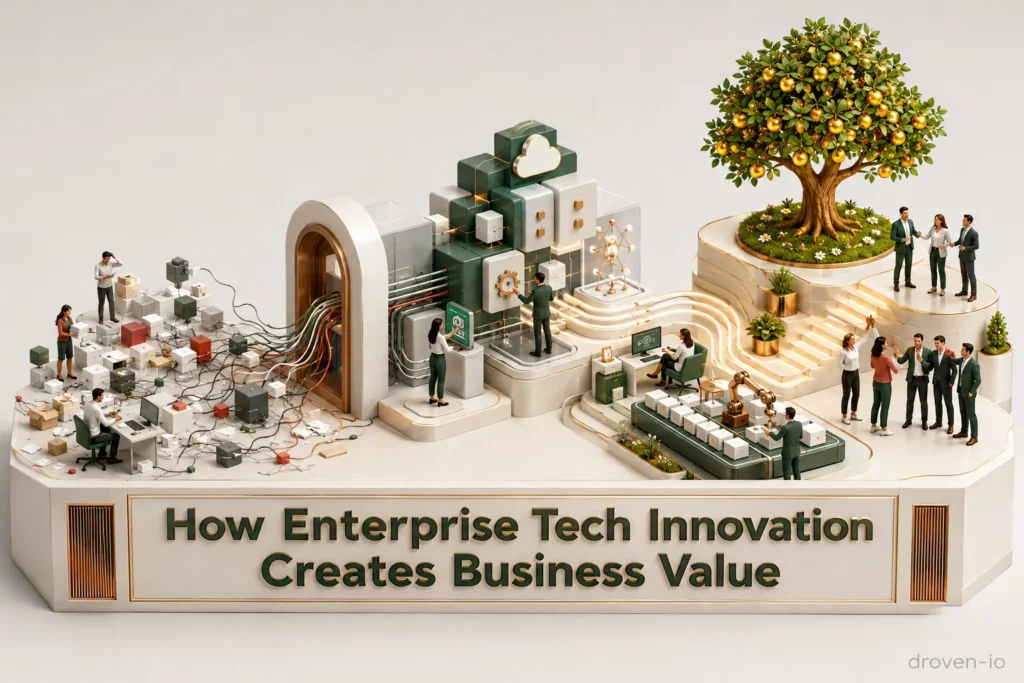
Technology becomes meaningful when it improves an important business outcome. An organization should not adopt a tool simply because it is popular.
Droven.io enterprise tech innovation topics can help readers connect technology with practical goals such as:
Higher Operational Efficiency
Automation can reduce manual data entry, repeated approvals, and administrative delays. Employees can spend more time on tasks that require judgment, creativity, or direct customer interaction.
Better Decision-Making
Analytics and AI can organize large amounts of information and identify patterns that may be difficult to detect manually. Decision-makers can use these insights alongside human experience and business context.
Improved Customer Experience
Businesses can use chatbots, recommendation engines, self-service portals, and customer analytics to provide faster and more relevant service. Human support should remain available for sensitive, complex, or unusual cases.
Greater Scalability
Cloud services and modular software can help companies add users, storage, and processing capacity without rebuilding their entire technology environment.
Stronger Business Resilience
Secure backups, remote collaboration systems, automated monitoring, and incident response plans can help an organization continue operating during disruptions.
Faster Product Development
DevOps, cloud platforms, AI coding assistants, and automated testing can reduce development time. Teams can release smaller improvements, collect feedback, and respond to market changes more quickly.
Practical Enterprise Use Cases
Enterprise technology affects nearly every department, but the correct application depends on the organization’s goals and available data.
Customer Service
Businesses can use AI assistants to answer routine questions, categorize requests, summarize customer conversations, and recommend relevant help articles. Difficult cases can be transferred to human agents with the conversation history attached.
Sales and Marketing
Technology can support lead scoring, customer segmentation, campaign analysis, personalized communication, and sales forecasting. Automated outreach should be reviewed to prevent irrelevant or excessive messages.
Finance
Finance teams can automate invoice processing, expense classification, reconciliation, fraud alerts, and management reporting. Human approval remains necessary for high-risk transactions and financial decisions.
Human Resources
HR departments can use digital systems for onboarding, training, employee records, workforce analytics, and internal support. Organizations must carefully manage privacy, fairness, and access to employee data.
Manufacturing
Connected sensors, computer vision, predictive maintenance, and production analytics can help identify equipment problems, reduce waste, and improve quality control.
Logistics
AI and analytics can support route planning, inventory forecasting, shipment tracking, warehouse operations, and delivery scheduling.
Software Teams
Developers can use automation for testing, code review support, deployment, monitoring, and incident management. AI-generated code should still be reviewed for security, accuracy, and maintainability.
A Step-by-Step Enterprise Innovation Framework
Droven.io enterprise tech innovation content is most useful when readers convert general insights into a structured evaluation process.
Identify the Business Problem
Begin with a specific challenge, not a preferred technology. A clear problem might be slow invoice processing, high customer support volume, frequent inventory shortages, or delayed management reports.
Measure the Current Process
Record the existing cost, processing time, error rate, customer impact, and employee effort. This creates a baseline for measuring improvement.
Check Data and System Readiness
Review whether the necessary information is accurate, accessible, secure, and compatible with the proposed solution. Also identify legacy systems that may be difficult to integrate.
Evaluate Possible Solutions
Compare multiple approaches. The best answer may involve improving the current process rather than purchasing an advanced AI platform.
Evaluation factors should include:
- Required features
- Integration options
- Security controls
- Scalability
- Total ownership cost
- Ease of use
- Vendor support
- Data portability
- Compliance requirements
- Implementation time
Run a Controlled Pilot
Test the solution with one team, workflow, or customer segment. A limited pilot makes it easier to discover problems without disrupting the entire organization.
Measure the Results
Compare pilot performance with the original baseline. Look beyond activity numbers and focus on business outcomes.
Improve Before Scaling
Use employee and customer feedback to correct problems. Document the process, assign ownership, and establish support procedures before expanding the solution.
Monitor Continuously
Technology, costs, security threats, and business requirements change over time. Regular monitoring helps determine whether the system continues to deliver value.
Metrics for Measuring Technology Innovation
A successful initiative should produce evidence, not just excitement. Depending on the project, useful key performance indicators may include:
- Cost per transaction
- Time saved per task
- Process completion time
- Error rate
- Customer satisfaction
- Customer response time
- System availability
- Employee adoption rate
- Revenue influenced
- Conversion rate
- Security incident frequency
- Return on investment
A basic ROI calculation can be expressed as:
ROI = (Financial Benefit − Total Cost) ÷ Total Cost × 100
Total cost should include software subscriptions, integration, training, maintenance, security, support, and employee time. Ignoring these expenses can make a project appear more profitable than it really is.
Who Can Benefit From Droven.io?
Droven.io enterprise tech innovation content can support several types of readers.
Business Owners
Owners can learn how digital systems may improve operations without needing to understand every technical detail.
Enterprise Decision-Makers
Executives can use general technology insights to ask better questions, assess opportunities, and communicate with technical teams.
IT Professionals
Technology teams can follow changes in AI, cloud infrastructure, software development, cybersecurity, and digital transformation.
Developers
Developers can explore emerging tools, development practices, automation methods, and potential applications of generative AI.
Marketing and Sales Teams
Commercial teams can learn how analytics, automation, CRM systems, and AI tools influence customer acquisition and engagement.
Students and Job Seekers
People entering the technology industry can use introductory content to discover growing fields, important skills, and possible career paths.
Risks and Limitations Readers Should Understand

Enterprise innovation offers valuable opportunities, but it also involves significant risks.
Technology Hype
Popular tools are often presented as universal solutions. In practice, results depend on data quality, employee adoption, integration, and process design.
Inaccurate AI Output
Generative AI systems can produce convincing but incorrect information. Important outputs require verification and human oversight.
Data Privacy Concerns
Employees may accidentally enter confidential customer or company information into tools that are not approved for enterprise use.
Integration Problems
A new platform may not connect smoothly with existing databases, applications, or legacy systems. Integration costs should be assessed before purchase.
Vendor Lock-In
Depending heavily on one provider can make future migration expensive. Organizations should review data export, contract, and interoperability options.
Employee Resistance
Workers may avoid a system that is confusing, unreliable, or introduced without proper communication. Training and employee involvement can improve adoption.
Weak Governance
Without clear ownership, different departments may purchase overlapping tools, create inconsistent data practices, or introduce security risks.
Generalized Information
Editorial content is designed for a broad audience. It may not account for an organization’s industry, location, infrastructure, budget, or legal obligations.
How to Evaluate Information Found on Droven.io
Technology articles are most valuable when readers verify them through a broader research process.
Before acting on a recommendation:
- Check when the information was published or updated.
- Separate general education from product-specific claims.
- Compare the information with official technical documentation.
- Confirm prices and features directly with providers.
- Review independent security and privacy information.
- Ask whether the advice applies to your industry and location.
- Test important claims through a small pilot.
- Consult qualified professionals for legal, financial, and security matters.
This approach allows readers to benefit from accessible explanations while reducing the risk of making decisions based on incomplete information.
Building a Responsible Enterprise Technology Strategy
A responsible technology strategy balances innovation with control. It should define what the organization wants to improve, how success will be measured, and which risks must be managed.
A strong strategy normally includes:
- Clear business objectives
- Executive sponsorship
- Technology ownership
- Data governance
- Cybersecurity requirements
- Employee training
- Budget and resource planning
- Pilot testing
- Performance measurement
- Human oversight
- Review and improvement cycles
Responsible innovation does not mean avoiding risk completely. It means identifying risks early and creating appropriate safeguards before scaling a solution.
Frequently Asked Questions
What is Droven.io enterprise tech innovation?
Droven.io enterprise tech innovation refers to the platform’s editorial coverage of artificial intelligence, automation, cloud computing, cybersecurity, data analytics, software development, and digital transformation for modern organizations.
Is Droven.io an enterprise software product?
No. Droven.io is an information and editorial platform. It publishes technology articles and guides rather than providing a single enterprise software application.
Does Droven.io provide AI automation tools?
Droven.io discusses AI tools, automation methods, and business applications. Readers should not confuse this coverage with a platform that directly builds or operates automated workflows.
What enterprise technologies does Droven.io cover?
Its broader technology coverage includes AI, generative AI, cloud computing, cybersecurity, data privacy, analytics, software development, web development, automation, and future-of-work topics.
Can small businesses benefit from its content?
Yes. Small businesses can use the content to understand digital tools, identify automation opportunities, and prepare for conversations with vendors. Solutions should still be evaluated according to budget, security, and business needs.
Is Droven.io suitable for beginners?
Many of its technology topics are relevant to readers who want accessible introductions to AI and digital transformation. More advanced projects will require additional technical documentation and professional expertise.
How should companies begin an enterprise innovation project?
They should begin by defining a measurable business problem, documenting the current process, assessing data readiness, and testing possible solutions through a limited pilot.
Conclusion
Droven.io enterprise tech innovation is best understood as an educational gateway to artificial intelligence, automation, cloud computing, cybersecurity, analytics, software development, and digital transformation. It helps make complex technology subjects more accessible to business owners, professionals, developers, and students.
The platform’s content can support discovery and early research, but enterprise innovation requires more than reading about new tools. Organizations must define a genuine business problem, verify information, assess risks, test solutions, train employees, and measure results.
The strongest technology strategy is not the one that adopts the most advanced tools. It is the one that connects appropriate technology with clear objectives, responsible governance, and measurable business value.