Introduction
Artificial intelligence has become one of the fastest-growing fields, creating exciting opportunities for students, professionals, and career changers. As businesses continue adopting AI-powered solutions, the demand for skilled AI professionals is expected to rise across industries. The droven.io ai career roadmap provides a structured approach to understanding the skills, tools, and learning path required to enter this competitive field.
Whether you want to become an AI engineer, machine learning specialist, data scientist, or AI product manager, having a clear roadmap helps you focus on the right skills instead of wasting time on outdated resources.
What Is the Droven.io AI Career Roadmap?
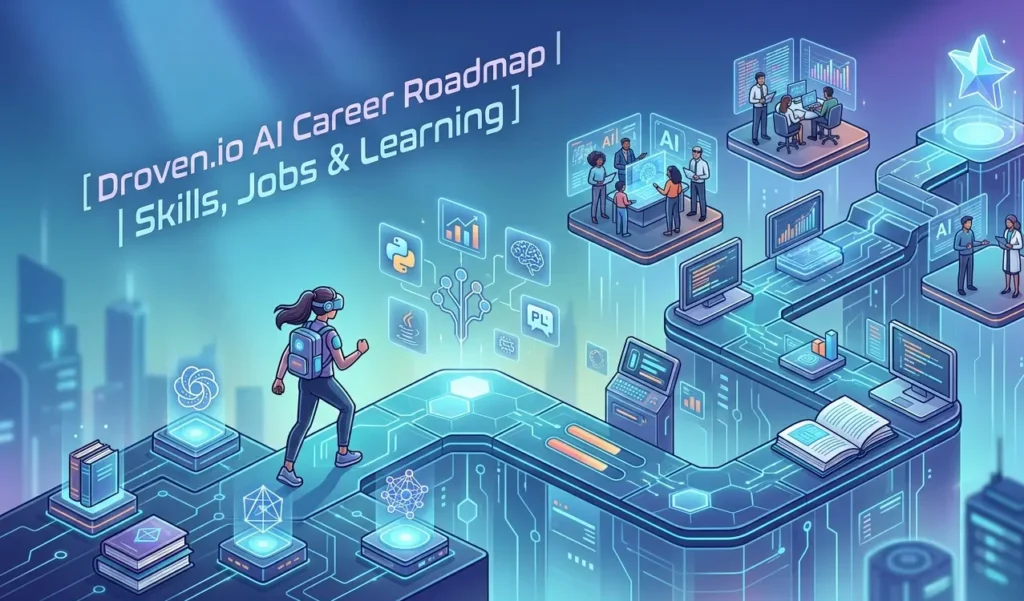
The droven.io ai career roadmap is a career-planning framework that outlines the essential knowledge and practical experience needed for artificial intelligence careers. Instead of learning random technologies, it emphasizes building a strong foundation before moving to advanced AI concepts.
A successful roadmap generally includes:
- Learning programming fundamentals
- Understanding mathematics for AI
- Studying machine learning algorithms
- Exploring deep learning frameworks
- Building practical AI projects
- Creating a professional portfolio
- Preparing for AI job interviews
Following a structured learning path allows beginners to develop skills gradually while gaining practical experience.
Why Follow an AI Career Roadmap?
Artificial intelligence covers many specialized fields. Without proper guidance, learners often struggle to decide what to study first.
A roadmap offers several advantages:
- Creates a clear learning direction
- Eliminates unnecessary topics
- Builds knowledge step by step
- Improves project development skills
- Helps prepare for real-world AI roles
- Increases confidence during interviews
Instead of jumping between tutorials, learners can follow a logical sequence that supports long-term career growth.
Skills Required for an AI Career
Success in AI depends on combining technical knowledge with analytical thinking.
Programming Skills
Programming is the foundation of artificial intelligence. Most AI professionals use Python because of its simplicity and extensive AI ecosystem.
Useful programming concepts include:
- Variables and data types
- Functions
- Object-oriented programming
- File handling
- APIs
- Exception handling
Version control using Git is another valuable skill for collaboration.
Mathematics
Many AI algorithms rely on mathematical concepts. Beginners should understand:
- Linear algebra
- Probability
- Statistics
- Calculus basics
- Matrices and vectors
While advanced mathematics can be helpful, practical understanding is often enough to start building AI models.
Data Handling
Since AI systems learn from data, professionals should know how to:
- Clean datasets
- Handle missing values
- Visualize information
- Analyze trends
- Prepare training data
Data preprocessing often determines the quality of AI model performance.
Machine Learning Fundamentals
Machine learning forms the core of modern artificial intelligence.
Important concepts include:
- Supervised learning
- Unsupervised learning
- Reinforcement learning
- Regression
- Classification
- Clustering
- Model evaluation
Understanding when to use each algorithm is more valuable than memorizing formulas.
Deep Learning Essentials
Once machine learning fundamentals are mastered, learners can move toward deep learning.
Popular topics include:
- Artificial neural networks
- Convolutional neural networks
- Recurrent neural networks
- Transformers
- Natural language processing
- Computer vision
These technologies power applications like chatbots, recommendation systems, image recognition, and autonomous systems.
AI Tools Every Beginner Should Learn
Practical skills matter more than theory alone.
Some commonly used AI tools include:
| Tool | Primary Purpose |
|---|---|
| Python | Programming language |
| NumPy | Numerical computing |
| Pandas | Data analysis |
| Matplotlib | Data visualization |
| Scikit-learn | Machine learning |
| TensorFlow | Deep learning |
| PyTorch | Neural network development |
| Jupyter Notebook | Experimentation and learning |
| Git | Version control |
Learning these tools prepares candidates for many entry-level AI positions.
Building Real AI Projects
Projects demonstrate practical abilities far better than certificates alone.
Beginner project ideas include:
- Spam email detection
- Movie recommendation system
- House price prediction
- Customer sentiment analysis
- Chatbot development
- Image classification
- Resume screening application
As experience grows, projects can become more advanced by integrating APIs, cloud services, and large language models.
Creating an AI Portfolio
A strong portfolio helps employers evaluate your practical experience.
Include:
- Personal AI projects
- GitHub repositories
- Project documentation
- Case studies
- Model performance results
- Technical blogs
- Problem-solving approaches
Quality matters more than quantity. A few polished projects often leave a stronger impression than dozens of incomplete ones.
Certifications and Continuous Learning
The AI industry evolves rapidly. Professionals should continuously update their knowledge through:
- Online courses
- Research papers
- Technical blogs
- AI communities
- Coding challenges
- Open-source contributions
Certifications can strengthen a resume, but practical project experience remains one of the most important hiring factors.
Common AI Career Roles
The droven.io ai career roadmap can lead to multiple career paths depending on your interests.
| Career Role | Primary Responsibilities |
|---|---|
| AI Engineer | Develop AI-powered applications |
| Machine Learning Engineer | Build predictive models |
| Data Scientist | Analyze data for business insights |
| Data Engineer | Build data pipelines |
| NLP Engineer | Develop language-based AI systems |
| Computer Vision Engineer | Create image recognition solutions |
| AI Researcher | Explore advanced AI techniques |
| AI Product Manager | Manage AI product development |
Each role requires different combinations of programming, mathematics, communication, and domain knowledge.
Mistakes Beginners Should Avoid
Many learners slow their progress by making common mistakes.
Avoid:
- Learning too many programming languages at once
- Ignoring mathematics completely
- Watching tutorials without building projects
- Skipping data preprocessing
- Memorizing algorithms without understanding concepts
- Expecting quick results
- Avoiding version control systems
Consistency produces better results than rushing through multiple courses.
AI Learning Roadmap Overview
| Stage | Focus Area |
|---|---|
| Stage 1 | Programming fundamentals |
| Stage 2 | Mathematics and statistics |
| Stage 3 | Data analysis |
| Stage 4 | Machine learning |
| Stage 5 | Deep learning |
| Stage 6 | AI projects |
| Stage 7 | Portfolio development |
| Stage 8 | Interview preparation |
| Stage 9 | Continuous learning |
Following these stages helps learners progress from beginner to job-ready professional.
Frequently Asked Questions
What is the droven.io ai career roadmap?
It is a structured learning path that guides aspiring AI professionals through programming, mathematics, machine learning, deep learning, projects, and career preparation.
Is the roadmap suitable for beginners?
Yes. Beginners can start with programming and gradually move toward advanced AI concepts without prior professional experience.
Which programming language should I learn first?
Python is generally considered the best starting language because of its readability and extensive AI libraries.
Do I need a degree to work in AI?
Not always. Many employers value practical skills, strong portfolios, and project experience alongside formal education.
How long does it take to become job-ready?
The timeline varies depending on prior experience, learning pace, and practice. Consistent study combined with hands-on projects often leads to steady progress.
Conclusion
The droven.io ai career roadmap offers a practical approach to entering one of today’s most promising technology fields. By focusing on programming fundamentals, mathematics, machine learning, deep learning, and real-world projects, learners can build the skills employers seek. Success in AI requires continuous learning, consistent practice, and a portfolio that demonstrates problem-solving ability. Instead of trying to master every AI topic at once, following a structured roadmap allows you to develop expertise step by step and prepare confidently for a rewarding career in artificial intelligence.